
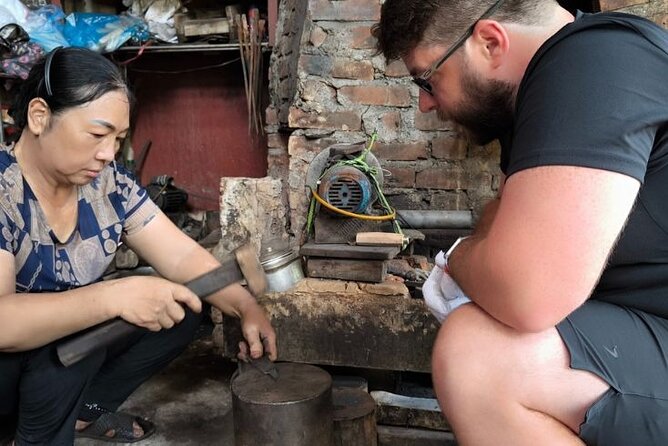
Reviewed · WORKSHOPS
Hanoi Knife Making Traditional Workshop
The hottest part of this Hanoi outing is not the road to the village. It is the moment your plain piece of steel turns orange in the forge, then begins to look like a knife under the hammer. At Da Sy, a family-run workshop keeps an old forging trade alive while making useful tools for modern life.
I like two things right away: you can choose your knife design, and you get a real souvenir rather than a factory-made trinket. Guides such as Tee, Nathan, and Khoi help translate, explain the process, and keep the visit moving. The catch is that this is an introduction for beginners, not a full blacksmith apprenticeship. The master may take over some tricky or dangerous work.
Key points to know before booking
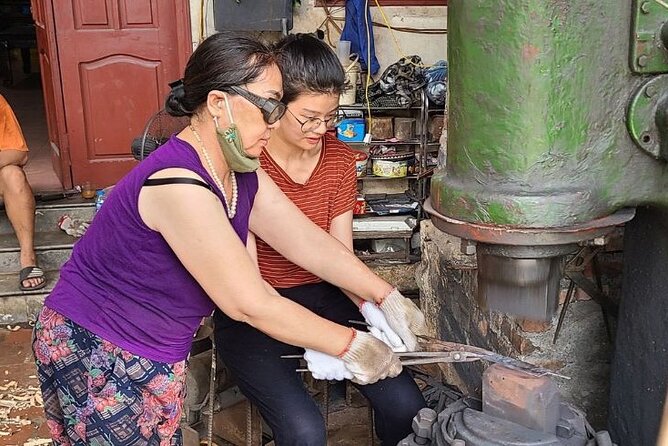
- Da Sy village gives the class a local setting: You visit a working craft village outside central Hanoi rather than a staged city workshop.
- You take part in the full knife process: Expect design, cutting, heating, hammering, shaping, grinding, sharpening, and handle work.
- English-speaking guides matter: Tee, Nathan, Khoi, and Minh have helped visitors understand instructions and speak with the craft family.
- You choose the finished knife: Select from sample designs or suggest a shape of your own, subject to what the workshop can make safely.
- Hotel pickup is included: A driver takes you from your hotel to the village and returns you afterward.
- Hands-on does not mean unsupervised: You can do much of the work, but machines, hot metal, and sharp edges require the maker’s control.
Why Da Sy is the right setting for this class
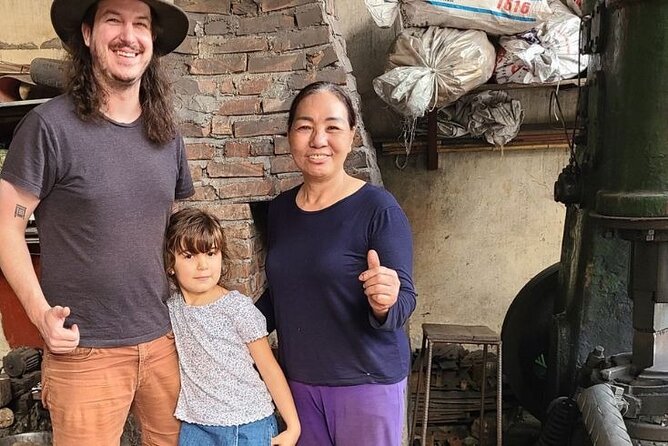
Da Sy, also written as Da Sy village, is known around Hanoi for its forging trade. The craft has been practiced there for several hundred years. The village once supplied weapons during wartime, while today its makers produce agricultural implements and knives.
That background gives the class more weight than a simple souvenir activity. You are not just heating metal for a photograph. You are visiting a place where forging is part of daily work and family tradition.
The workshop is family-run, and the teaching has a personal feel. The makers do not speak English, so your guide acts as translator between you and the craft family. That arrangement is important. It lets you ask questions, understand safety instructions, and learn why each stage matters instead of simply copying a motion.
You may be offered tea, fruit, or a small snack while visiting. This is a modest detail, but it helps the session feel like a welcome into someone’s workplace rather than a quick production line.
More Workshops in Hanoi:
- Hanoi Coffee Workshop: Taste Salt, Coconut and Egg Coffee
★ 5.0 · 1,286 reviews - Hanoi: Salt Coffee Workshop Awake Your Senses With 6 Brews
★ 5.0 · 792 reviews - Hanoi: Handcrafted Wood Carving Workshop with Local Artisan
★ 5.0 · 733 reviews
From Hanoi hotel to the forge
Hotel pickup is included, and you are asked to wait in the lobby about five minutes before departure. The drive takes you from Hanoi toward the village, with a guide introducing local history and daily life along the way.
The exact pickup time depends on availability when you book. The advertised activity lasts three hours, so allow that full block rather than planning a tight connection afterward. Some sessions may feel closer to two hours once the transport or final finishing work is complete, but the safe approach is to keep your morning or afternoon open.
Small groups are available. That matters here because the work area can become crowded around the forge, anvil, grinding wheel, and cutting equipment. A smaller group gives you more direct time with the master and makes it easier for the guide to translate.
Guides named by participants include Tee, Nathan, Khoi, and Minh. The guide’s role is more than pointing out the next tool. You will need help understanding instructions from the craft family, and a good guide also helps the visit run safely and comfortably.
Choosing a knife you can actually use
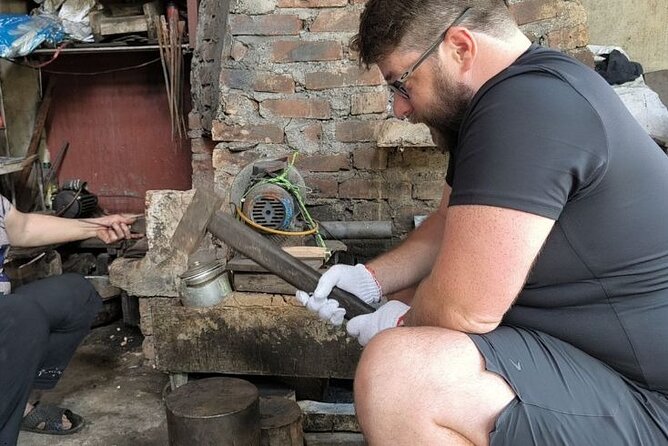
The first creative decision is the design. You may choose from several knife styles or use a photograph as a starting point. Some people select a kitchen knife, while others choose a shape inspired by Japanese designs or combine features from different examples.
This choice gives the finished item a personal touch, but keep your expectations practical. The workshop is making a simple knife during a short class, not producing a custom collector’s blade with weeks of fitting and polishing.
You sketch the blade shape onto a sheet of durable metal. The outline includes the blade and the tang, the narrow section that extends into the handle. This early step helps you understand that a knife is a set of connected parts, not just a sharpened strip of steel.
A useful tip is to decide what you want before the hot work begins. Think about the size, handle shape, and purpose. If you want a knife that will be practical at home, say so clearly through your guide. If you prefer a distinctive souvenir, ask about a more unusual design.
The forge, hammer, and anvil
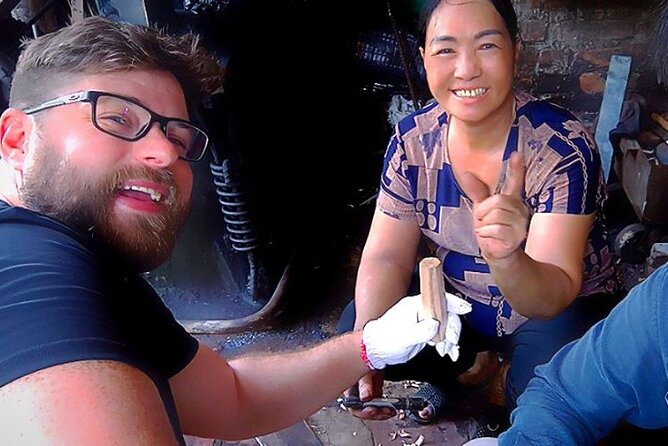
Once the shape is marked, the blade is cut from the metal. The workshop uses a hammer, cutter, and anvil, followed by a hydraulic cutting machine to trim imperfections.
This is the point where the class becomes genuinely physical. You may hold the tools, strike the heated metal, and work alongside the maker. The master demonstrates first, then guides your hands and adjusts your grip when needed.
Do not expect to control every blow. The metal is hot, the tools are heavy, and the shape must remain accurate. Some people spend much of the session working directly, while others prefer to let the craftsperson handle the difficult parts. You can usually choose how involved you want to be, but the workshop will keep control of dangerous steps.
That balance works well for first-timers. You get the satisfaction of making something yourself without being left alone with a red-hot blade. It also protects the final result. If your knife begins to wander off shape, the maker can correct it before the mistake becomes permanent.
Wear comfortable shoes, and follow instructions about gloves and protective handling. The work involves fire, sharp tools, metal dust, and machinery. Alcohol and drugs are not allowed, for good reason.
A few more Hanoi trips worth comparing
- Hanoi Jeep Tour: Food, Culture and Fun by Vietnam Army Jeep
★ 5.0 · 15,222 reviews - Hanoi: Water Puppet Show Tickets
★ 4.6 · 7,029 reviews - Hanoi Motorbike Tour: Food, Culture and Fun by Vintage Motorbike
★ 5.0 · 6,699 reviews - Hanoi: Guided Food Tour with Train Street Visit
★ 4.9 · 6,239 reviews
Shaping the blade with the master
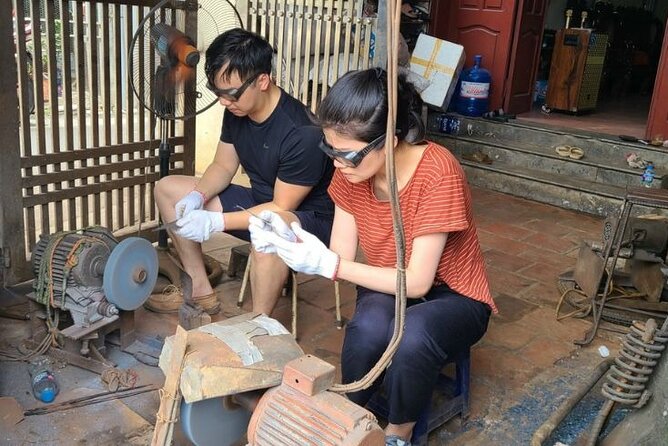
After the rough cut, you and the maker alternate blows to shape the blade. The process is repetitive, noisy, and surprisingly precise. A hammer strike that looks small can change the edge, spine, or angle of the knife.
This is where the skill gap becomes clear. A beginner can copy the motion, but the master knows how the steel is responding. The craftsperson watches the thickness and curve while deciding when to return the metal to the fire.
That is one of the best reasons to book this class instead of trying to copy the process from a video. The guide translates instructions, but the maker also teaches through demonstration, posture, hand position, and timing.
A hydraulic cutting machine removes rough or unwanted sections. This is not a stage you should treat as a hands-on challenge. The machine is one of the dangerous parts of the process, and the workshop may operate it for you while you watch.
If you want a long, technical blacksmith lesson, you may find the class too guided. If you want a safe first taste of forging and a finished knife to take home, the structure makes sense.
Heat treatment, grinding, and sharpening
The next stages turn a rough blade into a usable one. The metal is heated and treated, then sharpened on a grindstone. One part of the process includes soaking the blade in a tar-based chemical wash made from a family recipe.
You may not be expected to handle every chemical or machine directly. The class lets you see how the makers use these steps while allowing you to participate where it is safe. Ask your guide to explain the purpose of each stage, especially if you are interested in the difference between shaping, hardening, and sharpening.
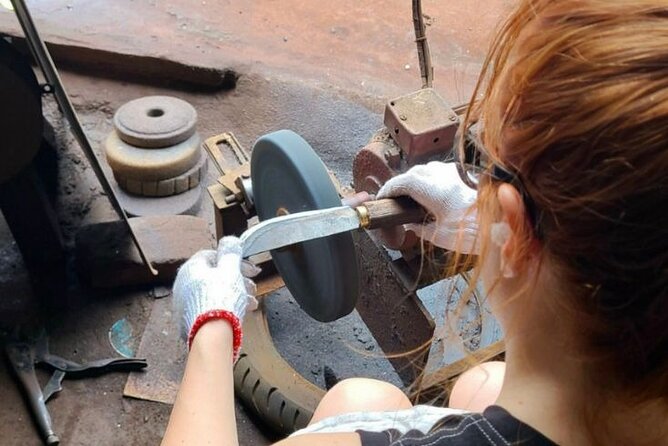
The grindstone is where the blade begins to look finished. It also requires care. A small change in angle can affect the edge, so the maker may guide your hand closely or complete the final sharpening.
Expect the finished knife to be very sharp. Some people describe leaving with kitchen knives or other practical blades, and the workshop can help produce a professional-looking result even when the student is a complete beginner.
You should not treat the knife as ready for checked luggage or international travel without checking your airline and destination rules. The activity information does not provide packing or customs guidance, so that responsibility remains with you.
Making the handle and finishing the souvenir
The handle is another chance to make the knife your own. You may help shape or carve the wooden handle, and the master can adjust it so it sits comfortably in your hand.
This part tends to appeal to people who enjoy design and small handwork more than heavy hammering. It also makes the souvenir feel personal. Two people can begin with similar blades and finish with knives that look and feel different.
The workshop’s skilled makers remain involved throughout. Their job is not simply to hand you tools and watch from a distance. They correct the blade, help with the handle, and make sure the final knife is usable.
Some visitors also buy extra knives from the workshop at a reasonable price. That option may appeal if you want a second kitchen knife or a gift, but ask your guide about the cost and any transport rules before purchasing.
What the English-speaking guide adds
The guide is central to the experience. Since the knife makers do not speak English, the guide translates instructions and explains the story of the village and the craft.
Tee is described as patient and clear, with a knack for explaining each step. Nathan has helped with translation, safety, local fruit, tea, and sweets during the visit. Khoi has handled the pickup, return journey, and communication with the workshop, while Minh has guided larger groups and helped demonstrate the work.
The exact guide depends on the date and group, so do not book expecting one specific person unless the operator confirms it. Still, the repeated pattern is useful: you need an English-speaking bridge between the workshop and the visitor, and this experience provides one.
A good guide also keeps the outing from feeling like a silent demonstration. Ask about the village, the metal, the family’s techniques, and the knife style you are making. The more questions you ask, the more you will get from the visit.
Is the $50 price good value?
At $50 per person, the price includes English-speaking instruction, equipment, one 500-milliliter bottle of water, hotel pickup and return, the craft master, and your finished knife.
That is good value if you want an activity with transport and a practical souvenir built into the price. You are paying not only for the metal object, but also for access to a working family workshop, translation, supervision, and the chance to use tools you would not normally handle on a city holiday.
The value is weaker if you mainly want a long, independent lesson. The master will do some work, especially with the hydraulic machine, chemical treatment, and final sharpening. Skilled DIY visitors may find the experience too controlled because the class is designed for beginners.
For most people, that is a fair trade. The finished knife is more likely to look good and function properly because an experienced maker is correcting the work. The activity also gives you a story to remember every time you use the knife.
There is a $10 surcharge on New Year, Tet, Liberation Day or Reunification Day on April 30, International Workers’ Day on May 1, and National Day on September 2.
Who will enjoy this Hanoi outing?
I would recommend it to you if you like practical souvenirs, local craft, hands-on work, and small family businesses. It is also a strong choice for couples, friends, families with older children, and small groups who want something different from temples and food tours.
It suits true beginners especially well. You do not need previous metalworking experience, and the master adjusts the level of help. You can take part in several stages without being expected to understand the tools in advance.
You may be less satisfied if you are an experienced blacksmith hoping to work independently. The class is short, and safety comes first. The master may take over when the blade needs precision or when equipment becomes risky.
The activity is not suitable for people over 95. Comfortable shoes are the main packing requirement, but closed, sturdy footwear is the sensible choice for a workshop involving hot metal and sharp tools.
Booking, cancellation, and practical details
You can reserve now and pay later, which helps if your Hanoi schedule is still changing. Free cancellation is available up to 24 hours before the activity for a full refund.
Check the available starting times before booking because the schedule is not fixed in the information provided. Confirm your hotel details carefully so the pickup goes smoothly, and be ready in the lobby a few minutes before the arranged time.
A small group is available, but group size can affect how much time you personally spend at the anvil. If direct participation matters most to you, request the smallest available option.
Should you book the Da Sy knife-making class?
Book it if you want a useful, handmade souvenir and a close look at one of Hanoi’s traditional trades. The strongest parts are the family workshop, patient instruction, flexible knife designs, hotel transport, and the chance to participate from raw metal to finished blade.
Skip it if you want a serious blacksmith course with full control over every tool. This is a guided beginner session, and some technical work remains in the hands of the master.
For most visitors, I think the $50 price is sensible. You leave with a knife, but the better souvenir is the memory of fire, hammer, steel, and a Vietnamese craft family showing you how their work is done.
FAQ
Where does the knife-making class take place?
The class takes place in Da Sy village, Dong Bac, Vietnam, on the outskirts of Hanoi. The village is known for its traditional forging trade.
How long does the activity last?
The advertised duration is three hours. Check the available starting times when booking.
Is hotel pickup included?
Yes. Pickup and return transportation are included. You should wait about five minutes in your hotel lobby at the arranged time.
Is the class taught in English?
The activity includes an English-speaking live guide. The guide translates between you and the knife-making family and explains the steps.
What does the $50 price include?
The price includes English instruction, the craft master, equipment, one 500-milliliter bottle of water, transportation, and the finished knife.
Can I choose the knife design?
Yes. You can choose from available knife designs, and some sessions allow you to use a photograph or personal idea as a starting point.
What should I bring?
Bring comfortable shoes. Follow the workshop’s instructions about gloves and safe handling of hot and sharp materials.
Can I cancel for a full refund?
Yes. You can cancel up to 24 hours in advance for a full refund. You can also reserve now and pay later.
Just added around Hanoi
- Private Crowd Free Hanoi: Morning Highlights of the City Experience★ 4.5 · 124 reviews
- Hoa Lo Prison and Little Paris Tour in Hanoi (French Quarter)★ 5.0 · 20 reviews
- Hanoi’s Old Quarter Street Food Experience and Train Street★ 5.0 · 22 reviews
- Old Quarter Food Tour in Hanoi★ 5.0 · 104 reviews
- Retro Hop-on-hop-off Bonbon City Tour: Classic Package★ 4.0 · 32 reviews
- [Hi-end] Private Hanoi Street Food Tour With Real Foodie★ 5.0 · 154 reviews
- Hanoi Street Food Tour★ 5.0 · 27 reviews
- Hanoi Street Food Tour with egg coffee making★ 5.0 · 22 reviews
Workshops, compared.

Vietnamese Coffee Culture and Coffee Making Class
Read our review →
Hoi An Full Lantern Making Class- A special Foldable lantern
Read our review →
Hanoi Coffee Workshop: Taste Salt, Coconut and Egg Coffee
Read our review →
Handcrafted Wood Carving Workshop with Local Artisan
Read our review →
Fun & Easy Vietnamese Coffee Workshop in Hồ Chí Minh City
Read our review →
Bat trang Pottery Ceramics Class in Hanoi’s Old Quarter | VN
Read our review →
Browse the lists this tour appears in