
Reviewed · WORKSHOPS
Hanoi Knife Making Traditional Workshop
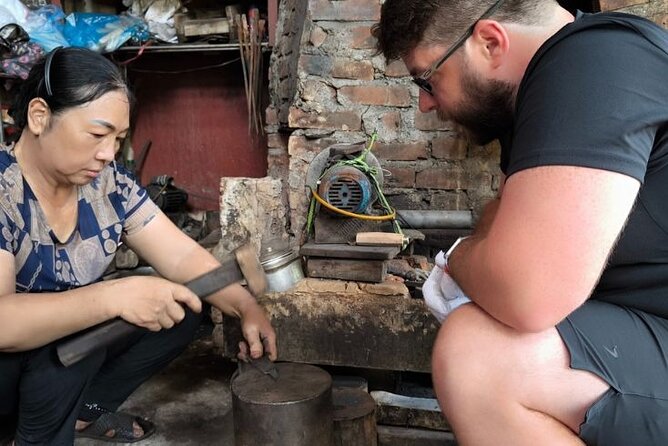
Hanoi’s knife-making workshop puts you beside a hot forge, hammer in hand, making a blade instead of shopping for one. You sketch the design, cut the metal, heat it in the coals, shape it on an anvil, and sharpen it on a grindstone.
I like the hands-on work and the chance to meet a family that has forged tools for generations. I also like the small maximum of 10 people, plus guides such as Nathan, who help explain the process in English. The main consideration is that this is a hot, physical workshop, not a quiet craft demonstration.
Key points at a glance
- Make a working knife from iron: You take part in the main stages, from drawing the blade to sharpening it.
- Visit a traditional forging village: The village has practiced metalworking for several hundred years and once supplied weapons during Vietnam’s wars.
- Work with a local family: The makers pass down their skills from a young age, and you can chat with them during the session.
- Small group, maximum 10 people: You should get more time at the anvil than in a large demonstration class.
- About three and a half hours: Pickup, transport, instruction, and workshop time fit into a half-day outing from Hanoi.
- Bring home an unusual souvenir: Your finished knife is a practical reminder of the work you put into it.
From Hanoi to a village built around forging
The experience takes place in a craft village outside Hanoi, rather than in a city-center studio. That setting matters. You are not simply watching a staged activity for tourists. You are visiting a community where forging has been part of working life for several hundred years.
The village once played a role in making weapons during Vietnam’s wars. Today, its makers focus on agricultural implements and other useful metal goods. That change gives the workshop a clear connection to daily life: the skill is not treated as a museum piece, but as a trade that continues to serve practical needs.
Pickup is offered, and the tour includes an air-conditioned vehicle. That is useful in Hanoi’s heat, especially after time near a forge. The total experience lasts about three hours and 30 minutes, so you can fit it into a morning or afternoon without giving up an entire day.
The exact route and pickup timing are not provided, so confirm those details when you book. The activity is listed in Hanoi, but the forging village is on the outskirts, and the transfer is part of the experience.
More Workshops in Hanoi:
- Hanoi Coffee Workshop: Taste Salt, Coconut and Egg Coffee
★ 5.0 · 1,286 reviews - Hanoi: Salt Coffee Workshop Awake Your Senses With 6 Brews
★ 5.0 · 792 reviews - Hanoi: Handcrafted Wood Carving Workshop with Local Artisan
★ 5.0 · 733 reviews
Meeting the family behind the workshop
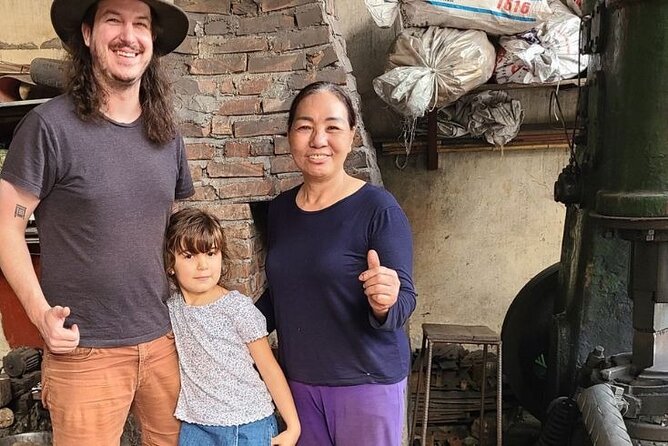
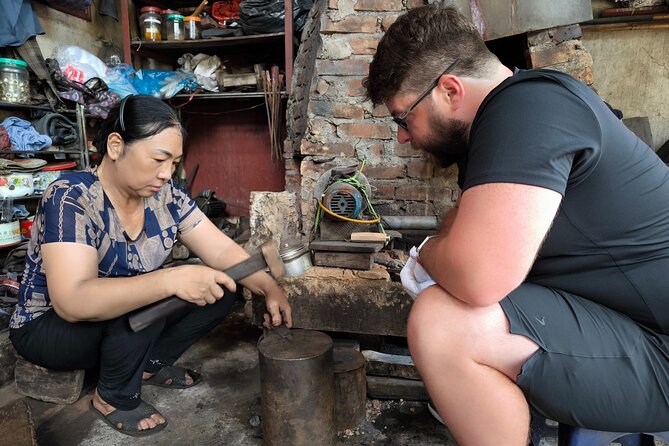
At the workshop, you meet local makers whose family has worked in forging for generations. One family member explained that people in the trade can begin learning at around age 12. That detail helps you understand why the makers handle hot metal, heavy tools, and quick decisions with such confidence.
You will have an English-speaking guide during the outing. Nathan is one guide associated with the experience, and his role includes helping with the journey as well as keeping the workshop understandable and engaging. A guide is especially useful here because the work moves quickly, and you need clear instructions before using tools or approaching the forge.
The family setting is one of the strongest parts of the class. You can chat with the makers and see how skill is passed between generations. Do not expect a formal lecture on Vietnamese metalworking. The value comes from standing close to the work, asking questions, and seeing a real family trade at close range.
The workshop is also a social experience. You are not working alone at a bench with a printed instruction sheet. You alternate with the maker during the shaping stage, which gives you a direct sense of how much timing and control the job requires.
Sketching a blade you can actually make
The class begins with design. You sketch the shape of your blade on a sheet of metal selected for durability. This is a small step, but it changes your relationship with the finished object.
Instead of receiving a standard knife at the end, you make choices about the blade’s size and shape. One person who took the class was able to choose the knife size, so you should have some room to make the piece feel like your own. The available options may depend on the material and the maker’s guidance.
The design stage is also where the practical limits become clear. A simple cooking knife is the goal, not an elaborate custom blade. Keep your design sensible and listen closely to the maker before the metal is cut.
The included iron material covers the metal you need for the class. You do not need to arrive with supplies. Since tips and lunch are not included, budget separately for those costs.
Cutting, heating, and hammering the metal
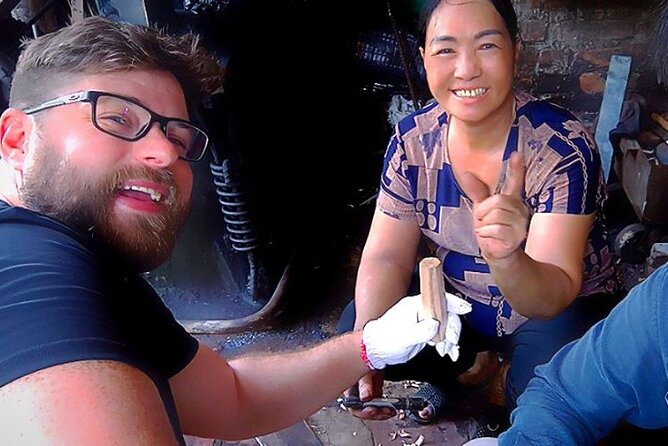
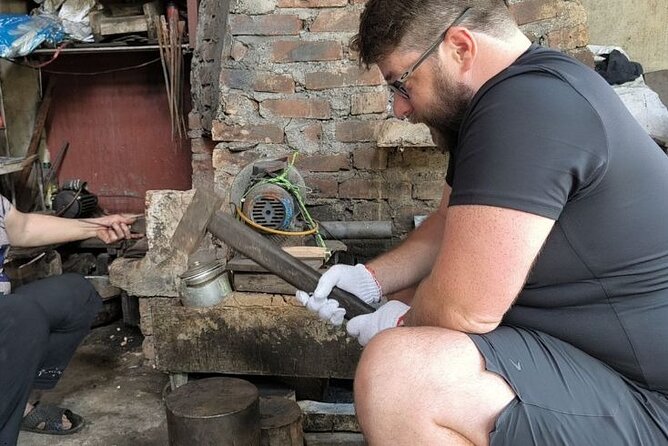
Once the blade is drawn, you use a hammer, cutter, and anvil to cut out the blade and tang. The tang is the section that extends into the handle, so this early stage shapes more than just the visible cutting edge.
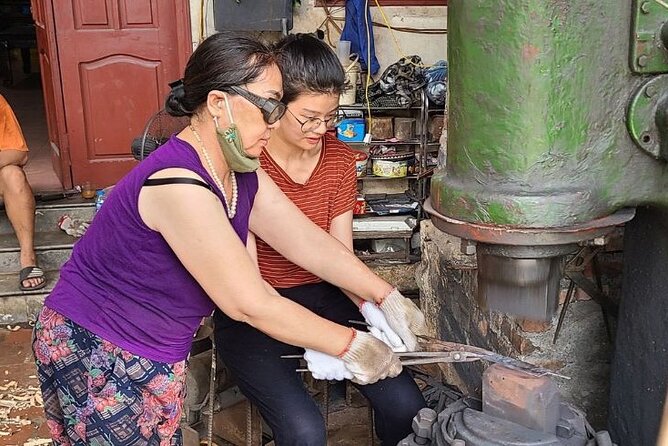
The metal then goes into crackling embers. This is where the workshop becomes physical. You work close to heat, watch the metal change, and follow the maker’s instructions about when and how to strike it.
You alternate blows with the maker to shape the blade. That shared rhythm is important. A skilled bladesmith can read the metal and control the force of each strike, while you are learning the basic movement. Do not expect to produce perfect results on your first swing. The point is to take part in the process and feel how much judgment the work demands.
Any rough sections can be trimmed with a hydraulic cutting machine. This is a useful reminder that traditional forging does not mean every part of the process must rely on hand tools. The makers combine old methods with equipment that helps bring the blade into a cleaner shape.
I would wear clothes and shoes you do not mind using in a working environment. The physical fitness requirement is moderate, and the class involves standing, handling tools, and working near heat. The supplied information does not give specific clothing rules, so ask the provider if you have concerns about heat, movement, or footwear.
A few more Hanoi trips worth comparing
- Hanoi Jeep Tour: Food, Culture and Fun by Vietnam Army Jeep
★ 5.0 · 15,222 reviews - Hanoi: Water Puppet Show Tickets
★ 4.6 · 7,029 reviews - Hanoi Motorbike Tour: Food, Culture and Fun by Vintage Motorbike
★ 5.0 · 6,699 reviews - Hanoi: Guided Food Tour with Train Street Visit
★ 4.9 · 6,239 reviews
Shaping the blade beside an expert
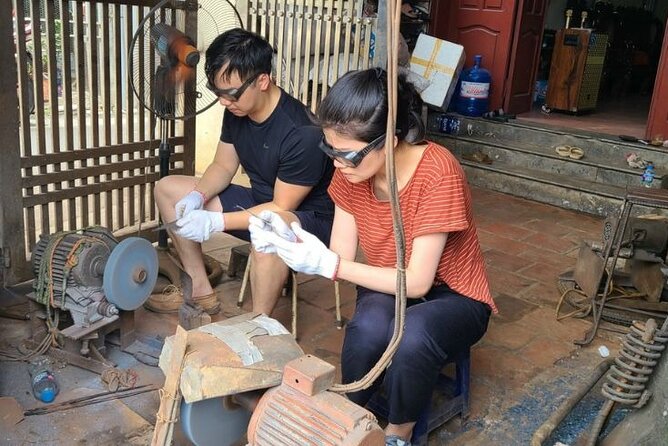
The shaping phase is the heart of the class. You strike the heated metal while the maker helps guide the form. This lets you see the difference between simply hitting metal and shaping it with purpose.
The work can be challenging, but that is part of its appeal. You are not being asked to perform a polished demonstration. You are learning a sequence of actions under supervision, with the family correcting imperfections and helping you move forward.
A small group helps here. With a maximum of 10 people, the maker and guide have a better chance of giving each person attention than they would in a large class. Still, a group of 10 is not private instruction. If you want the most time at the anvil, ask how the workshop divides hands-on turns when booking.
This is also the stage where patience matters. The metal may need repeated heating and shaping, and the finished blade depends on many small adjustments. You should book this class because you like making something slowly and imperfectly, not because you expect a factory-perfect object in a few minutes.
Sharpening, grinding, and the family recipe
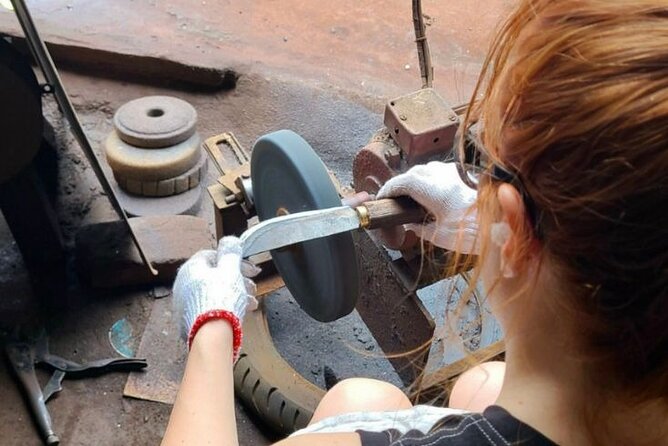
After shaping, the blade is sharpened on a grindstone. This is not one quick pass. The sharpening process includes several phases, and the finish depends on careful grinding.
One unusual step involves soaking the blade in a tar-based chemical wash. The family uses a secret recipe for this part of the treatment. You are given an insight into a technique that belongs to the workshop, while the exact formula remains within the family.
That small detail adds character to the experience, but you should not assume you will be taught every technical secret. Some parts of a traditional trade are shared openly, while others stay with the makers. The useful lesson is seeing how heat, shaping, grinding, and treatment work together to produce a usable knife.
The completed item is intended as a cooking knife and a souvenir. It is more personal than a mass-produced gift because you helped create it. At the same time, the information provided does not specify the final blade dimensions, handle material, or rules for carrying it during onward travel. If you are flying after the workshop, ask the provider how to pack the finished knife.
What the $50 price includes
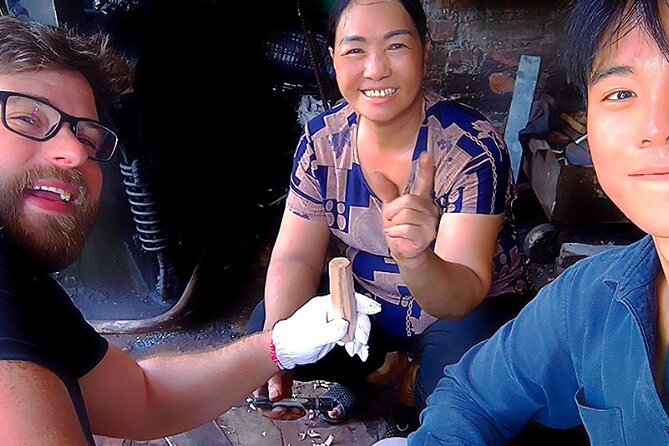
The listed price is $50 per person. For a half-day activity, that can be fair value if you want transport, instruction, materials, and a finished object rather than just a short demonstration.
The price includes an air-conditioned vehicle, iron material, and an English-speaking guide. Pickup is offered, and group discounts may be available. Those inclusions matter because arranging transport to an outlying village on your own could take time, while sourcing suitable metal and tools would be impractical.
Lunch is not included, and tips are separate. The class lasts about three and a half hours, so plan your meal around the start or finish of the activity. You should also check the pickup details before paying, since the available information does not state the exact pickup area or schedule.
The strongest value is the combination of access and participation. You meet the makers, use traditional tools, and take home your own knife. If you only want to see a blacksmith at work, a shorter demonstration might cost less. If you want to make something with your own hands, the fee is easier to justify.
Who will enjoy this workshop most
I would recommend this experience to curious adults, couples, small groups, and anyone who wants a souvenir with a story. It suits people who enjoy practical work and do not mind getting warm, standing for extended periods, or making several attempts before the blade looks right.
It also works well for visitors who have already seen Hanoi’s major sights and want an outing tied to local craft. The village visit gives you a different view of the area around Hanoi, while the family workshop provides direct contact with a working tradition.
This is less suitable if you want a relaxed indoor class, have difficulty with moderate physical activity, or dislike heat and noise. The activity requires attention around tools and hot metal. The description does not provide detailed accessibility information, so ask before booking if you need specific physical accommodations.
The class can suit children only if the provider confirms that they are allowed and properly supervised. The supplied information does not state a minimum age, so do not assume young children can take part.
Booking details that can affect your day
You receive confirmation at the time of booking, and the tour accepts mobile tickets. That makes it easy to keep the booking on your phone while moving around Hanoi.
The group maximum is 10 people. Group discounts are offered, though the discount amount is not stated. If you are booking with friends or family, ask for the current group rate rather than assuming the standard price applies to everyone.
Free cancellation is available if you cancel at least 24 hours before the local start time. Changes or cancellations inside that 24-hour window are not refunded or accepted.
The workshop depends on good weather. If poor weather cancels the activity, you are offered another date or a full refund. The experience also requires a minimum number of participants, so if that minimum is not met, you are offered another date or experience, or a full refund.
Should you book the Hanoi knife-making workshop?
Book it if you want an active, unusual half-day outside central Hanoi and like the idea of returning home with something you helped make. The local family, the generational craft, Nathan’s patient guidance, and the small group size give the class more substance than a quick souvenir stop.
Skip it if you want a polished sightseeing tour with little physical effort. The forge is hot, the work takes concentration, and the final knife may show the marks of a beginner’s hand. For many people, that is the point.
At $50, the workshop offers solid value for transport, an English-speaking guide, materials, instruction, and a personal souvenir. Just leave room in your schedule for lunch, confirm pickup details, and book at least 24 hours ahead if you want to keep the cancellation option.
FAQ
Where does the knife-making workshop take place?
The activity is based in Hanoi and visits a traditional craft village on the outskirts of the city. The village is known for its long-standing forging profession.
How long does the experience last?
The workshop lasts approximately three hours and 30 minutes.
How much does the workshop cost?
The listed price is $50 per person. Group discounts are offered, but the discount amount is not specified.
Is transportation included?
Yes. An air-conditioned vehicle is included, and pickup is offered.
Is an English-speaking guide provided?
Yes. The experience includes an English tour guide. Nathan is one guide associated with the activity.
What will I make during the class?
You will make a simple knife, described as a cooking knife. You take part in sketching, cutting, heating, shaping, and sharpening the blade.
Is lunch included?
No. Lunch is not included in the price. Tips are also not included.
How many people can join the workshop?
The activity has a maximum group size of 10 people.
Can I cancel for a full refund?
Yes, if you cancel at least 24 hours before the experience start time. Cancellations or changes made less than 24 hours before the start time are not refunded. Weather or minimum-participant cancellations may result in a different date or a full refund.
Just added around Hanoi
- Private Crowd Free Hanoi: Morning Highlights of the City Experience★ 4.5 · 124 reviews
- Hoa Lo Prison and Little Paris Tour in Hanoi (French Quarter)★ 5.0 · 20 reviews
- Hanoi’s Old Quarter Street Food Experience and Train Street★ 5.0 · 22 reviews
- Old Quarter Food Tour in Hanoi★ 5.0 · 104 reviews
- Retro Hop-on-hop-off Bonbon City Tour: Classic Package★ 4.0 · 32 reviews
- [Hi-end] Private Hanoi Street Food Tour With Real Foodie★ 5.0 · 154 reviews
- Hanoi Street Food Tour★ 5.0 · 27 reviews
- Hanoi Street Food Tour with egg coffee making★ 5.0 · 22 reviews
Workshops, compared.

Vietnamese Coffee Culture and Coffee Making Class
Read our review →
Hoi An Full Lantern Making Class- A special Foldable lantern
Read our review →
Hanoi Coffee Workshop: Taste Salt, Coconut and Egg Coffee
Read our review →
Handcrafted Wood Carving Workshop with Local Artisan
Read our review →
Fun & Easy Vietnamese Coffee Workshop in Hồ Chí Minh City
Read our review →
Bat trang Pottery Ceramics Class in Hanoi’s Old Quarter | VN
Read our review →
Browse the lists this tour appears in