
Reviewed · CRAFT VILLAGE TOURS
Hanoi Knife-Making Class:Join the Legacy in Blacksmith’s Workshop
Da Sy village has forged blades for centuries, and this class puts you beside the anvil rather than behind a glass case. With artisan Tuyen, a female blacksmith who has spent 44 years protecting the craft, you design, heat, hammer, shape, grind, and sharpen a knife of your own.
I like the genuine village setting and the fact that you do the work yourself, from the first blade sketch to the final edge. I also like the small-group format, with no more than 10 people, plus helpful guides such as Mint, Nick, or Tulip to explain the process.
The main consideration is that this is real metalwork, not a quiet craft lesson. Expect heat, hammering, grinding, and close guidance. You should also check your home country’s rules before trying to pack a knife in your luggage.
Key points to know before you book
- Forge a working knife from start to finish: Design the blade, cut the metal, shape it, grind it, and sharpen it.
- Meet artisan Tuyen in Da Sy: She is the officially recognized female artisan connected with this workshop and has 44 years of experience.
- Learn an unusual sharpening method: The final process includes a tar-based wash passed down through the artisan’s family.
- Work in a small group: The class accepts a maximum of 10 people, so you can expect close instruction.
- Bring home your own creation: The finished knife is a useful souvenir, not just a decorative object.
- Plan for a practical Hanoi outing: The meeting point is in Đa Sỹ, Kiến Hưng, Hà Đông, outside the central Old Quarter area.
Why Da Sy is the right place to make a knife
This class works because it takes place in Da Sy, a village known for blacksmithing over many generations. The village once supplied weapons during Vietnam’s wars, and its workshops still carry on the old trade through practical household blades and tools.
That setting matters. You are not simply copying a craft in a room built for tourists. You are working in an artisan’s home workshop, surrounded by the tools and routines of a living trade. The experience connects the finished object to a real place and to the people who keep the work going.
I also like that the story is not limited to old weapons or male blacksmiths. Tuyen is presented as the only officially recognized female artisan in the trade, and she has devoted 44 years to preserving it. That gives the class a human focus. You are learning from a skilled craftsperson with a long personal connection to the work, not just following a generic demonstration.
The class lasts about two and a half hours. That is enough time to cover the full process without turning the day into a long technical course. You will still need to work at a steady pace, especially if you want to shape the handle and finish the blade carefully.
More Craft Village Tours in Hanoi
- Incense Village, Hat Making & Lacquer Artisan Small Group Hanoi
★ 5.0 · 1,266 reviews - Incense Village, Conical Hat, Lacquer Art, Small Group From Hanoi
★ 5.0 · 1,170 reviews - Hanoi: Incense Village, Hat, and Lacquer Artisanal Tour
★ 4.6 · 1,005 reviews
Designing the blade before the fire
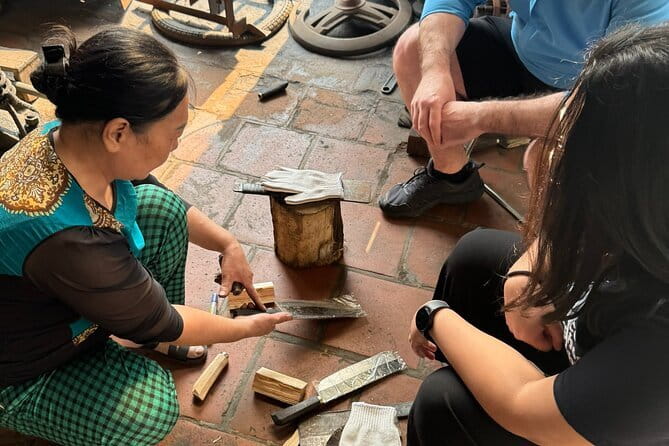
The class begins with design. You sketch the blade shape on a selected piece of durable metal, choosing the outline and general form before any cutting starts.
This first stage is more important than it sounds. A knife is not just a strip of sharpened steel. The shape affects how it looks, how it fits the hand, and how it might be used in the kitchen. Starting with your own drawing gives the final piece a personal mark from the beginning.
The metal is chosen for strength and quality, and you work with the blade and tang in mind. The tang is the part that extends into the handle, so you are planning the whole knife rather than decorating a ready-made blade.
You should not expect unlimited design freedom. The available metal, the class time, and safe working limits will guide your choices. That is sensible. A skilled artisan can help turn your idea into something that can actually be forged, held, and sharpened.
Cutting, heating, and hammering the steel
Once the design is set, you cut out the blade and tang with traditional tools. The workshop provides the hammers, cutters, anvil, forge, and safety equipment, so you do not need to bring specialist gear.
The metal is heated in the forge before shaping. This is the most physical part of the class. You take turns hammering the hot metal on the anvil while the artisan guides your movements and checks the form.
I like this part because it makes the craft easy to understand. You feel that the knife is being made through repeated work, not produced by a mysterious old trick. The fire softens the metal, the hammer gives it shape, and the artisan’s corrections keep the result on track.
You should also keep your expectations realistic. Beginners will not work with the speed or precision of a professional blacksmith after one session. The artisan will help ensure the blade takes proper form, and the class is designed for beginners, but your finished knife may show small marks that reveal your hand in the process. That is part of its value.
The hydraulic machine helps refine rough edges after the hammering. This gives the blade a smoother shape without asking you to complete every heavy task by hand. It is a useful mix of old and modern workshop methods: traditional forging does the creative shaping, while machinery helps bring the piece to a workable finish.
Shaping the handle and making the knife yours
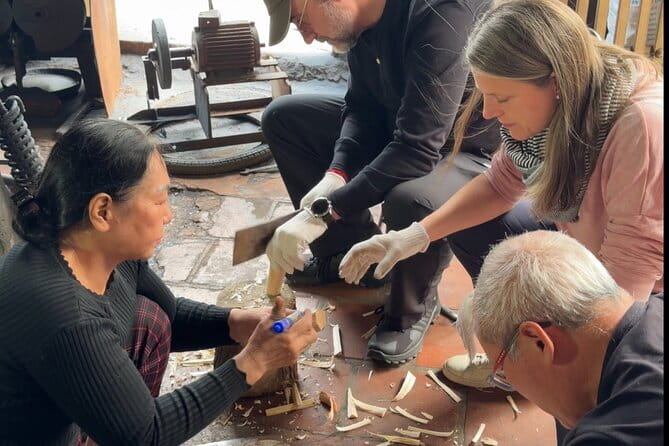
The blade gets the attention, but the handle is where the knife becomes personal. The experience includes handle work, and one detailed account describes starting with a block of wood with bark before turning it into a finished grip.
You may be able to customize the handle as well as the blade. The exact choices can depend on the workshop and the pace of your session, so it is wise to ask at the start what options are available that day.
Handle work is a good reason to book your own ticket even if you are traveling with someone. One person can make one knife, and another person can watch or take part in the process. If you mainly want a shared activity rather than two knives, the experience has been offered in a way that allows one ticket to cover one handmade knife.
The handle also affects the final feel of the tool. A blade can look impressive, but it needs a grip that fits comfortably and holds securely. The artisan’s guidance is especially useful here, since a beginner may focus on appearance and overlook how the knife sits in the hand.
Same trip, a completely different kind of day:
- Hanoi Jeep Tour: Food, Culture and Fun by Vietnam Army Jeep
★ 5.0 · 15,222 reviews - Hanoi: Water Puppet Show Tickets
★ 4.6 · 7,029 reviews - Hanoi Motorbike Tour: Food, Culture and Fun by Vintage Motorbike
★ 5.0 · 6,699 reviews - Hanoi: Guided Food Tour with Train Street Visit
★ 4.9 · 6,239 reviews
Grinding and the family sharpening method
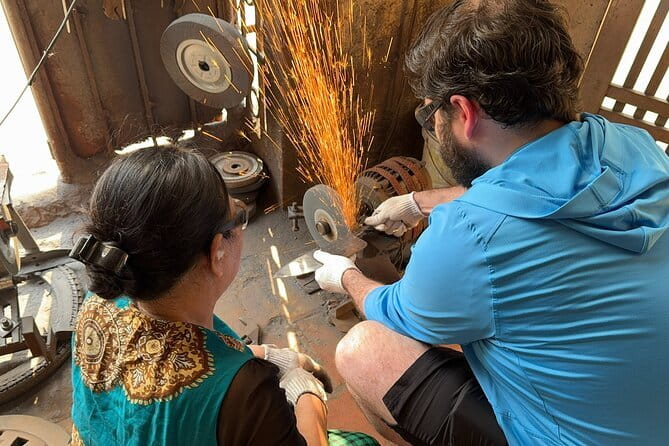
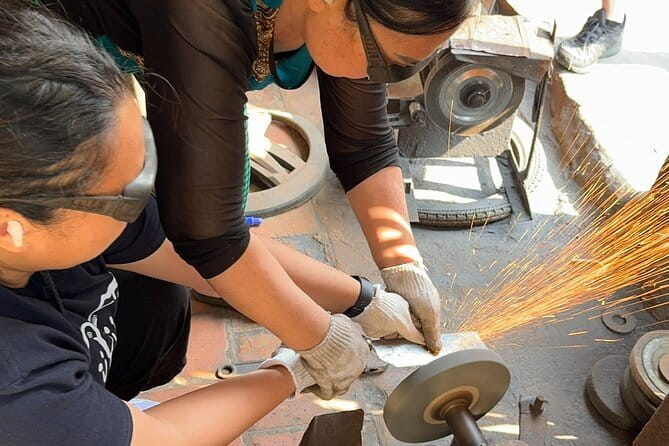
After forging and shaping, you grind the blade on a grindstone. This stage takes patience. The goal is not simply to scrape metal away, but to form a clean edge without ruining the blade’s shape.
The final sharpening process includes a tar-based wash, described as an old family secret passed down through generations. That detail gives the class a special local character. It is not the sort of technique you usually encounter in a standard craft workshop, and it shows how practical knowledge can survive through family teaching.
You should still treat the knife as a working tool, not a souvenir to handle casually. It will be sharp, and all necessary safety equipment is provided. Follow the artisan’s instructions closely during grinding and sharpening, especially when your attention is split between the moving stone and the angle of the blade.
The finished knife is intended to be useful for preparing food. It also carries the marks of the making process, from your chosen outline to the hammering and handle work. That makes it a stronger keepsake than a mass-produced kitchen item.
The role of Tuyen and the English-speaking guides
The artisan is the heart of the experience, but the guide can make a major difference. Guides named in the experience include Mint, Nick, and Tulip.
Mint is described as the interpreter who works alongside Tuyen. That matters because blacksmithing depends on small instructions: where to strike, how to hold the piece, when to stop, and how to keep the edge even. Clear interpretation helps you follow the process instead of guessing.
Nick has also been described as a friendly guide who gives practical Hanoi food recommendations, which is useful if you are fitting the class into the end of a city stay. Tulip is another named guide associated with the class and its explanations.
Guide assignments can change, so do not assume you will have one particular person unless the operator confirms it. The useful point is that the experience includes guided interpretation rather than leaving you to communicate only through gestures.
The class is capped at 10 people. That is large enough to give the workshop energy, but small enough that close help should be possible. If you want the most individual attention, a private class may be available by arrangement. One booking was made privately with a car after direct communication with the provider, but transport and a private format should be confirmed rather than assumed.
Price, time, and what the $45.51 covers
At $45.51 per person, this is not the cheapest hands-on activity in Hanoi. It costs more than a short demonstration because you are paying for about two and a half hours of instruction, workshop access, materials, tools, safety equipment, and the knife you make.
I consider the price reasonable if you value the finished object and the chance to learn a traditional trade. You are not simply watching an artisan make something. You design and work on the knife through several stages, with professional help when the job becomes difficult or requires machinery.
The value is less clear if you want a relaxed, passive cultural visit. This is a work session. You will hammer, grind, and pay attention to safety. If your main goal is a calm craft class with little physical effort, a different activity may suit you better.
The listed starting point is Đa Sỹ, Kiến Hưng, Hà Đông, Hanoi, and the class ends back at the meeting point. The information provided does not include standard hotel pickup, so check the transport plan before booking. The area is near public transportation, but the precise route and travel time from your accommodation are not specified.
Who will enjoy this class most
I would recommend it to you if you like making useful objects, want a strong connection to local craft, or have already seen Hanoi’s usual food and sightseeing stops. It is also a good fit for couples, families with suitable participants, and small groups who want to leave Vietnam with something they helped create.
The class suits beginners. The artisan works step by step and provides the tools and safety equipment. You do not need prior blacksmithing experience.
It may be less suitable if you dislike heat, noise, physical work, or sharp tools. The session is also not ideal for anyone hoping to finish a perfectly uniform professional knife. The appeal is the process and the personal result, including the small evidence of your own work.
Most people can participate, and service animals are allowed. The maximum group size is 10. Specific age limits or detailed mobility information are not provided, so contact the operator if you have questions about a particular need.
Getting your handmade knife home
Before you book, check the rules for carrying knives in your home country. One participant specifically noted the need to check airport regulations, even with a relatively short knife.
Do not rely on guesswork at the airport. Airline and national rules can differ, and a handmade blade may need special packing or checked baggage. The provided information does not state that shipping is included, so ask the operator if you need help sending the knife home.
This small bit of planning can prevent a fine souvenir from becoming a travel problem on your final day.
Cancellation and booking details worth knowing
You receive confirmation when you book, and the ticket is mobile. The experience offers free cancellation if you cancel at least 24 hours before the local start time.
Cancellations made within 24 hours are not refunded, and changes inside that period are not accepted. If you are arranging transport to Đa Sỹ or trying to fit the class around a flight, leave yourself some room rather than booking it too close to departure.
Should you book the Da Sy knife-making class?
Book it if you want a hands-on Hanoi experience with a real craft tradition behind it. The combination of Da Sy village, artisan Tuyen, detailed instruction, and a knife you shape yourself gives the class more substance than a quick souvenir workshop.
I would especially choose it near the end of a Hanoi stay, when you have time to confirm airport rules and can enjoy taking home a practical reminder of Vietnam. Ask about transport, the guide assigned to your session, handle options, and how to carry the knife home.
Skip it if you want a quiet activity or have no interest in handling hot metal and sharpening tools. For everyone else, this is a strong choice at $45.51, with a clear payoff: you learn how a blade is made, meet a craftsperson carrying on a long village tradition, and leave with something no factory could make exactly the same way.
FAQ
Where does the knife-making class take place?
The class starts and ends at Đa Sỹ, Kiến Hưng, Hà Đông, Hanoi, Vietnam.
How long does the experience last?
The class lasts approximately 2 hours and 30 minutes.
How much does the class cost?
The listed price is $45.51 per person.
What do I make during the class?
You make your own knife by designing the blade, cutting and forging the metal, shaping it, working on the handle, grinding the blade, and sharpening it.
Who teaches the class?
The class is led by skilled artisans, including Tuyen, a recognized female artisan with 44 years of experience in the craft. Guides such as Mint, Nick, and Tulip may assist with interpretation and explanations.
Are tools and safety equipment provided?
Yes. The artisan’s house provides all tools and the necessary safety equipment for knife making.
How many people can join?
The maximum group size is 10 people.
Can most people participate?
Most people can participate, and service animals are allowed. The experience is also near public transportation. Specific information about age limits and detailed mobility access is not provided.
Does the activity include transportation?
The listed meeting point is in Đa Sỹ, and the activity ends there. Standard transportation or hotel pickup is not listed as included, so confirm your transport arrangements before booking.
Can I cancel for a full refund?
Yes. You can receive a full refund if you cancel at least 24 hours before the local start time. Cancellations or changes made less than 24 hours before the start are not accepted for a refund.
More Workshops in Hanoi
- Hanoi Coffee Workshop: Taste Salt, Coconut and Egg Coffee
★ 5.0 · 1,286 reviews - Hanoi: Salt Coffee Workshop Awake Your Senses With 6 Brews
★ 5.0 · 792 reviews - Hanoi: Handcrafted Wood Carving Workshop with Local Artisan
★ 5.0 · 733 reviews - Bat trang Pottery Ceramics Class in Hanoi’s Old Quarter | VN
★ 4.9 · 240 reviews
Just added around Hanoi
- Hanoi Coffee Workshop: Master 6 Signature Vietnamese Coffee★ 5.0 · 171 reviews
- Majesty Of Untouched Northern Vietnam Tour 6 Days★ 5.0 · 63 reviews
- Minh’s Unique Street Food Adventure★ 5.0 · 81 reviews
- Hanoi Private Transfers One Way (by Luxury Limousine Vans)★ 4.5 · 51 reviews
- Thang Long Water Puppet Show Entrance Tickets★ 4.0 · 84 reviews
- Ha Noi Street Food Tour★ 5.0 · 30 reviews
- Life Drawing Class – Art Workshop at Art Tutor Hanoi★ 5.0 · 44 reviews
- L’essence Honeymoon Package (for couples) 270’★ 5.0 · 48 reviews
Craft Village Tours, compared.

Cai Be Mekong Delta Tour: Cooking Class, Cycling & Craft Villages
Read our review →
Incense Village, Hat Making & Lacquer Artisan Small Group Hanoi
Read our review →
Countryside Tour with Silk Village & Elephant Falls
Read our review →

Incense Village Private Tour from Hanoi to Ninh Binh Old Capital
Read our review →
Incense + Hat Villages/ Temple of Literature, Hoa Lo Prison
Read our review →
Private Tour Incense Village, Hat village & Train Street Coffee
Read our review →
Browse the lists this tour appears in