
Reviewed · WAR HISTORY TOURS
Explore DMZ in Private: Vinh Moc & Khe Sanh from Hue
The Vinh Moc Tunnels are the heart of this long day from Hue. You walk through the underground village where more than 300 people lived during heavy bombing, then connect that human story with the battlefields at Khe Sanh and the former border at Hien Luong Bridge. It is a sobering look at the Vietnam War from several angles.
I like the private car and guide, since the long drive is easier when you can stop, ask questions, and travel at your own pace. I also like the mix of sites: military history at Khe Sanh, geography at the Rockpile and Dakrong Bridge, and civilian survival in Vinh Moc.
The drawback is the distance. This is a 10 to 11-hour day, with a great deal of time on the road, and lunch is not included. The tunnels are narrow and warm, so anyone with claustrophobia should think carefully before booking.
Key points to know before booking
- Vinh Moc is the emotional centerpiece: See the underground rooms, including the maternity area, where villagers sheltered during wartime bombing.
- Khe Sanh adds battlefield context: Visit the old airstrip, sandbag bunkers, weapons, photographs, and the small museum.
- The Rockpile and Dakrong Bridge explain the geography: These stops connect the remote mountains with the Ho Chi Minh Trail.
- A private setup makes the long route easier: Your group has its own car, driver, and English-speaking guide.
- The road day is substantial: Plan on roughly 10 to 11 hours from Hue, with about four hours assigned to each main stop area.
- Guide quality matters: Guides named in strong reports include Sam, Hai, Thach, Hoa, and Mai, though one booking had difficulty understanding the guide’s English.
Why this Hue day trip is worth your time
The former Demilitarized Zone is not a quick side trip from Hue. The key sites lie far to the northwest, so the day involves a very early start and long stretches in the car. But the route gives you something that a city museum cannot: you see the mountain roads, former military positions, divided river, and underground village in the places where they mattered.
I like the way this tour brings together military strategy and ordinary life. Khe Sanh tells you about a major battle. Hien Luong Bridge shows how a country was physically divided. Vinh Moc makes the war personal by showing where families slept, worked, and tried to protect their children.
The private format is important here. Your group travels in its own air-conditioned car with a driver and guide, rather than being tied to a large bus schedule. You receive bottled water, hotel pickup and drop-off within 5 kilometers of Hue city center, and admission fees are included. You still need to pay for lunch, other drinks, and personal expenses.
At $101 per person, the tour is not the cheapest way to see the DMZ. It is a fairer deal for a small group that values private transport and a guide over the lowest possible price. If you are traveling alone, the cost is harder to justify. For two or more people, the convenience becomes more appealing, especially since the route would be tiring to arrange independently in one day.
More War History Tours in Hue
- From Hue: DMZ Tour with Vinh Moc Tunnels and Khe Sanh Base
★ 4.9 · 503 reviews - DMZ Tour Hue – Deluxe group tour full day
★ 5.0 · 383 reviews - DMZ & Vinh Moc Tunnels – Private Historical Tour from Hue
★ 5.0 · 188 reviews
The long road from Hue to Khe Sanh
The day begins early. That is not just a tour-company preference. The route is long, and the schedule needs much of the day to cover Khe Sanh, the central DMZ sites, and Vinh Moc.
The private vehicle lets you settle into the drive with your own group. Bottled water is supplied, while lunch and additional drinks are your responsibility. Since no lunch venue is fixed in the information provided, bring some patience and be ready to follow your guide’s local suggestion or arrange food during the day.
A private guide can add real value on this road. The region’s names and military movements can blur together without explanation. A good guide can connect the places you pass with the larger story of the war, the division between North and South Vietnam, and the later effects on local communities.
The guide and driver combination has been one of the strongest parts of the experience. Sam has been praised both as a careful driver and as someone who explains Vietnamese history and present-day culture during the journey. Hoa has also received warm comments for conversation and driving, while guides named Hai, Thach, and Mai have been singled out for clear explanations and engaging stories.
That praise comes with one useful caution: English ability may vary from guide to guide. One account describes a guide whose English was difficult to understand and whose presentation felt politically one-sided. If history and interpretation are the main reason you are booking, it is sensible to ask about the guide when confirming.
Khe Sanh Combat Base and the road to the Ho Chi Minh Trail
The first major section covers the Khe Sanh area and several important points along the route. The schedule allows roughly four hours here, including the Rockpile, Dakrong Bridge, and Khe Sanh Combat Base.
The Rockpile
The Rockpile is a limestone hill that served as a U.S. Marine Corps observation post. Its importance comes from position rather than grand remains. From a remote mountain setting, it helps you understand how high ground was used to watch and control movement.
There is not a large site to walk through here, so keep your expectations realistic. The value is in the setting and the guide’s explanation. You are looking at a piece of military geography, not a preserved fort with a long series of rooms.
Same trip, a completely different kind of day:
- Hue to Hoi An ( Hoi An to Hue) Top Gear with Lefamily Riders Tours ( 1 way)
★ 5.0 · 3,156 reviews - Easy Rider private tour via Hai Van pass from Hue – Da Nang – Hoi An (1Way|Loop)
★ 5.0 · 1,542 reviews - Hue Customizable Tour with Imperial Citadel & Forbidden City
★ 4.9 · 937 reviews - Imperial City, Hue: Day Tour from Hoi An and Da Nang
★ 4.6 · 830 reviews
Dakrong Bridge
Dakrong Bridge marks the beginning of the legendary Ho Chi Minh Trail. The bridge sits among rugged mountains and ethnic minority villages, giving you a link between military history and the people who still live in the region.
This is one of the stops where the drive itself matters. You are not simply checking off a bridge. The surrounding mountains help explain why supply routes were hard to control and why this corridor mattered so much during the war.
The stop also broadens the day beyond U.S. and North Vietnamese military events. You get a sense of the local setting and the cultural groups connected with the area. The supplied information does not promise a village visit or a formal cultural program, so treat the surrounding communities as part of the view rather than a separate activity.
Khe Sanh Combat Base
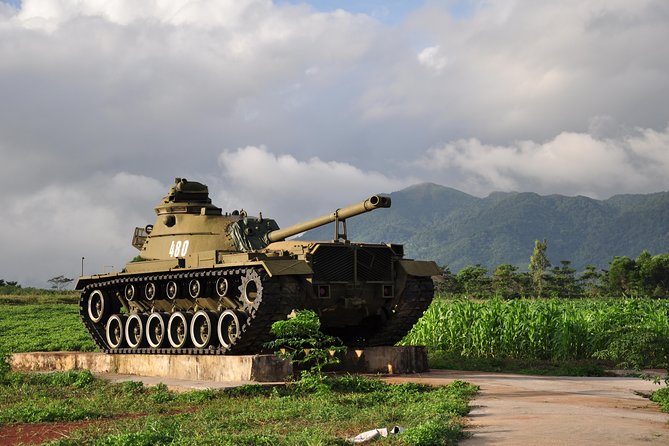
Khe Sanh is the main battlefield stop. You visit the former airstrip, sandbag bunkers, and a small museum with weapons, photographs, and stories from the fierce 1968 siege.
I find this part most useful when you arrive with a little patience. The remains are not a complete wartime base, and the museum is described as small. The experience depends heavily on the guide, who can explain how the airstrip and defensive positions fit into the fighting.
The site gives the war a physical scale. The airstrip shows the role of supply and evacuation. The bunkers show the effort required to protect a fixed position. The photographs and weapons provide a more direct link to the people who fought there.
Allow time to listen rather than rush through for photographs. The military sites can look spare at first glance, but their meaning grows when you understand the pressure placed on the base during the 1968 siege.
Doc Mieu, Hien Luong Bridge, and the divided country
The second major section also receives roughly four hours and moves toward the former dividing line. It includes Doc Mieu Base, Hien Luong Bridge and the Ben Hai River, followed by the Vinh Moc Tunnels.
Doc Mieu Base
Doc Mieu was a former U.S. military outpost near the 17th parallel and part of the McNamara Line. Little remains, so this stop works best as a historical marker rather than a grand attraction.
Your guide’s explanation is especially useful here. The point is to understand the effort to create a barrier and control movement near the dividing line. Without context, a sparse site can seem underwhelming. With context, it becomes part of the military plan that shaped the region.
Hien Luong Bridge and the Ben Hai River
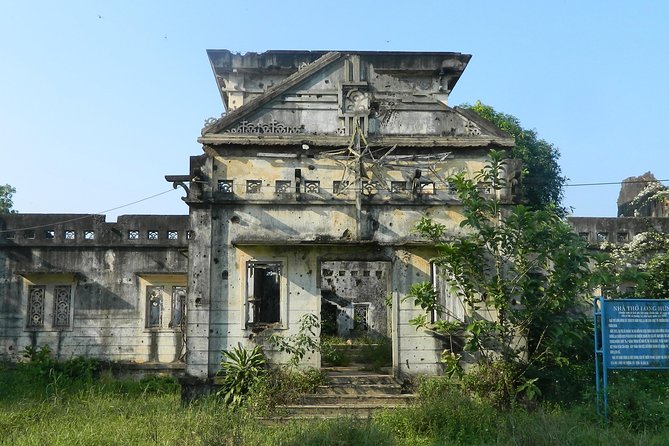
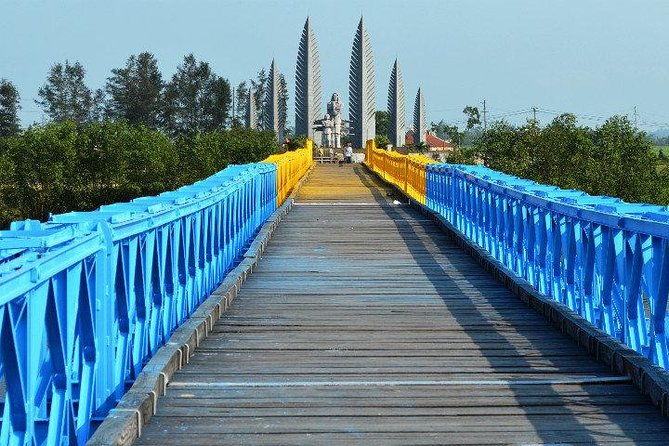
Hien Luong Bridge and the Ben Hai River offer the clearest physical symbol of Vietnam’s division. You can see the bridge, flag towers, and a small museum explaining the story of a country split between North and South.
This is a quieter stop than Khe Sanh, but it carries a different weight. The river and bridge make an abstract political boundary visible. You are looking at a place where division was not just a line on a map. It affected movement, families, politics, and daily life.
The stop is also a useful bridge between the battlefield sites and Vinh Moc. At Khe Sanh, you focus on military pressure. At Hien Luong, you see the political structure behind that conflict. At Vinh Moc, you learn how civilians adapted to the danger.
Going underground at Vinh Moc Tunnels
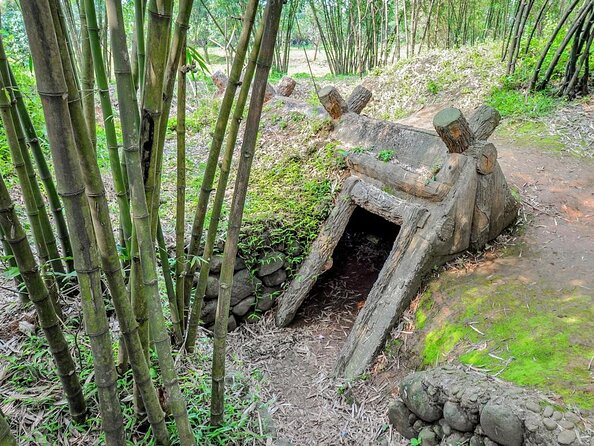
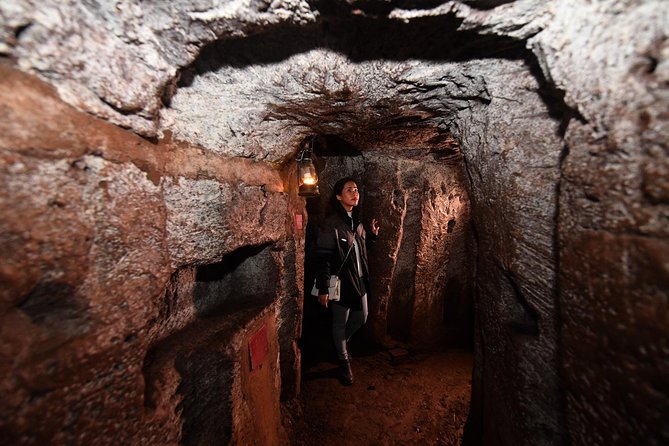
Vinh Moc is the part most likely to stay with you. More than 300 villagers lived in this underground network during heavy bombing. You walk through the tunnels and see how the settlement was organized below ground.
The tunnels are narrow and warm. That is not a minor detail. You need to be comfortable in confined spaces, and anyone with claustrophobia may find the visit stressful. The tour information says most people can participate, but that general note should not outweigh your own comfort level.
The maternity area is a particularly striking detail. It shows that this was not simply a military hideout. People lived there, raised children, and tried to keep ordinary life going under extraordinary conditions.
The tunnel visit works because it changes the focus from military hardware to civilian endurance. You can read about bombing and displacement in a museum, but moving through the low underground passages gives you a physical sense of the conditions. Do not expect a polished attraction. The narrow spaces are the point.
The tunnels are also a reason to choose this private tour over a quick, crowded sightseeing run. Your guide can explain the rooms and daily life, and your group can move at a more useful pace. You will still have to follow the site’s practical limits, but a private arrangement gives you more room to ask questions.
What the guide and driver add
This tour rises or falls on its people. The sites are significant, but the remains at Doc Mieu and Khe Sanh are not always self-explanatory. A strong guide helps you understand what you are seeing and keeps the long road from becoming dead time.
The most praised names include Sam, Hai, Thach, Hoa, and Mai. Sam has been praised as both driver and history guide. Hai has been praised for bringing family experience and postwar life into the explanation, even though she was not born during the war. Thach has been described as well informed about the war and Vietnam more generally.
You cannot assume that a particular guide will be assigned unless the operator confirms it. Still, these names may be useful when you ask about arrangements. The driver matters too. A careful driver makes a long day less tiring, and the private car gives you a more comfortable base between sites.
The guide’s point of view can shape the day. Vietnam’s wartime history is politically sensitive, and interpretations may differ. One difficult account points to unclear English and a strongly pro-communist presentation. That does not define every guide, but it is a fair reminder to ask questions and expect a Vietnamese perspective rather than a perfectly neutral classroom lecture.
Timing, comfort, and who should book
This is best for someone with a real interest in the Vietnam War, the American War, or the history of the DMZ. It also suits anyone who prefers a private vehicle and personal guide to a large group tour.
You should be ready for:
- A 10 to 11-hour day from Hue
- An early departure
- Long periods in the car
- Narrow, warm tunnels
- Walking around outdoor historical sites
- Lunch and drinks at your own cost
Children must be accompanied by an adult. Most people can participate, and the tour is near public transportation, though hotel pickup and drop-off are included only for addresses within 5 kilometers of Hue city center.
The tour is less suitable if you want a relaxed day with plenty of free time. It is also a poor match if confined spaces make you anxious or if you dislike long drives. The route packs a great deal into one day because the sites are spread across the region.
Free cancellation is available if you cancel at least 24 hours before the start time. Changes or cancellations inside that 24-hour window are not accepted for a refund.
Should you book this private DMZ tour?

I would choose this tour if Khe Sanh and Vinh Moc are high on your Hue list and you want the convenience of a private car. The strongest reasons are the complete route, the guide-led historical context, and the chance to see both battlefield remains and the underground village.
The main question is not the price alone. It is whether you want to spend most of a day reaching these distant sites. At $101 per person, the tour makes more sense for a small group that will value private transport, an English-speaking guide, and included admission fees.
Book it if you want a serious history day and can handle the road time. Skip it if you prefer a slower Hue itinerary, dislike tunnels, or want a short introduction to the DMZ. For the right visitor, Vinh Moc alone can justify the effort, while Khe Sanh and Hien Luong give the day the wider context that makes the journey worthwhile.
FAQ
How long does the DMZ tour from Hue last?
The tour lasts approximately 10 to 11 hours.
What sites are included?
The route includes the Rockpile, Dakrong Bridge, Khe Sanh Combat Base, Doc Mieu Base, Hien Luong Bridge, the Ben Hai River, and Vinh Moc Tunnels.
Is hotel pickup included?
Yes. Pickup and drop-off are included for hotels within 5 kilometers of Hue city center.
Is this a private tour?
Yes. Only your group participates, and you travel by private car with a driver and an English-speaking guide.
Is lunch included?
No. Lunch and drinks other than the supplied bottled water are not included.
Are entrance fees included?
Yes. Entrance fees are included in the tour price.
Can children join the tour?
Yes, but children must be accompanied by an adult.
Are the Vinh Moc Tunnels suitable for everyone?
Most people can participate, but the tunnels are narrow and warm. People with claustrophobia may find them uncomfortable.
What is the cancellation policy?
You can cancel for a full refund up to 24 hours before the experience starts. Cancellations or changes made less than 24 hours before the start time are not accepted.
Just added around Hue
- Hai Van pass private car tour from Hue-Da Nang-Hoi An (1Way|Loop)★ 5.0 · 19 reviews
- Guided Private Hue City Tour from Da Nang or Hoi An★ 5.0 · 29 reviews
- Private Full-Day Tour of Hue from Da Nang or Hoi An City★ 4.5 · 24 reviews
- Hue Imperial City: Full-Day Guided Tour from Da Nang or Hoi An★ 4.0 · 25 reviews
- Hue City Tour From Da Nang- Hue Day Trip From Danang★ 5.0 · 28 reviews
- Hue Imperial City Daily Ingroup Tour via Hai Van Pass★ 5.0 · 151 reviews
- Hue Imperial City Private Tour with Local Experts★ 5.0 · 137 reviews
- Imperial Hue And Hai Van Pass Full-day Tour★ 5.0 · 57 reviews
War History Tours, compared.

Cu Chi Tunnels Tour from HCM City – Morning or Afternoon
Read our review →
DMZ Tour with Vinh Moc Tunnels and Khe Sanh Base
Read our review →
Cu Chi Tunnels Half-Day History Tour with Guide
Read our review →

Cu Chi Tunnels and Mekong Delta Signature Tour
Read our review →
Cu Chi Luxury Group Tour – Tapioca and Cake Half Day
Read our review →
Adventure Cu Chi Tunnels: Vietnam War Underground Network AM/PM
Read our review →Browse the lists this tour appears in